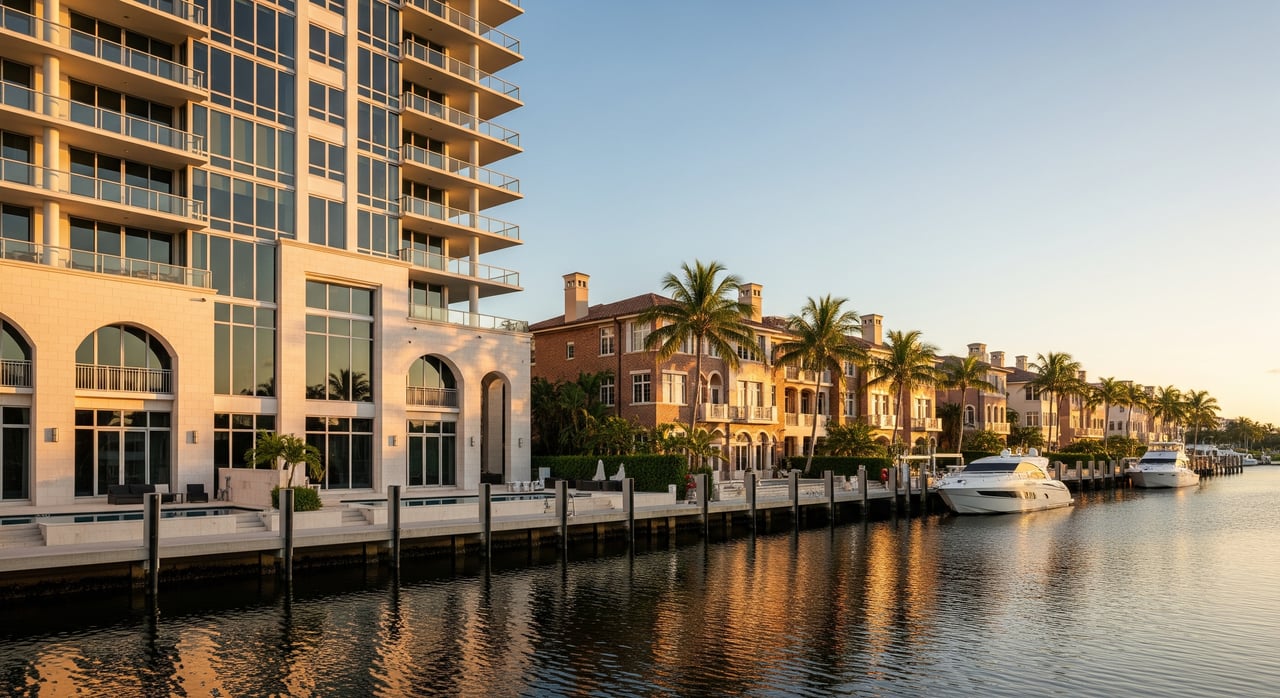
Torn between a waterfront condo and a waterfront townhome in Fort Lauderdale? You are not alone. Both offer access to the city’s canals, Intracoastal Waterway, and the New River, yet they come with very different trade-offs in maintenance, dock control, insurance, fees, and day-to-day lifestyle. In this guide, you will learn what truly separates these options, what to inspect before you buy, and which choice tends to fit different buyer goals. Let’s dive in.
Quick take: condo vs townhome
Here is a fast side-by-side to help you frame the decision.
| Factor |
Waterfront Condo |
Waterfront Townhome |
| Ownership |
Condo form (Florida Statutes Chapter 718): you own the interior; the association controls common elements like exterior, roof, and shared docks if designated |
Fee-simple (Chapter 720) or condo-form townhome: fee-simple owners usually own land and exterior; condo-form townhomes act more like condos |
| Maintenance |
Association handles exterior, building systems, landscaping, and common seawall/docks if common elements |
Owner often handles exterior: roof, facade, yard, and private dock or seawall if deeded |
| Dock access |
Association-managed docks, assigned slips, or nearby marina leases; rules and fees vary |
Deeded private dock more common in fee-simple setups; greater control, but you handle upkeep |
| Insurance |
Association master policy covers building; you carry an HO-6 for interiors; flood coverage often needed separately |
Fee-simple owners carry HO-3 or HO-5 that covers structure and contents; flood and wind coverage are key |
| Fees |
Generally higher monthly dues when amenities and shared infrastructure are extensive |
Often lower dues, but you pay directly for exterior and dock/seawall work |
| Privacy |
Higher density and shared spaces; controlled access and amenities |
More private entries and outdoor areas; fewer shared walls in many layouts |
| Lending |
Condo projects must meet lender eligibility requirements |
Simpler for fee-simple; condo-form townhomes face similar lender scrutiny as condos |
Maintenance and ownership basics
In a condominium, you usually own from the drywall in. The association owns and maintains the building exterior, roof, elevator systems, and often the seawall and docks when these are designated common elements. This lowers your daily maintenance burden but shifts costs into monthly dues and potential special assessments.
Townhomes can be fee-simple or condo-form. In fee-simple, you typically own the land and structure, which often means you handle the roof, exterior, yard, and any private dock or seawall tied to your lot. Condo-form townhomes function more like a condo, with the association managing the exterior. Always confirm your exact responsibilities in the recorded documents.
Reserve funds matter on the water. Seawalls and docks are major capital items. If reserves are light, even well-run communities may levy special assessments. Before you buy, review the budget and reserve study to see what is planned for coastal infrastructure and when it might hit your wallet.
Dock access and boating limits
Fort Lauderdale’s water network combines the Intracoastal Waterway, man-made canals, and the New River. Canal depth, bridge clearances, and proximity to Port Everglades all impact what you can operate from your property. Two homes a few blocks apart can have very different boat size limits and tidal conditions.
Typical dock setups include private deeded slips, association-owned slips, or leases at nearby marinas. Private, deeded docks deliver the most control and convenience for active boaters. Association docks are convenient too, but they follow community rules for size, assignment, and fees. If a property does not include a dock, a marina slip lease can be a practical workaround.
Permitting is a factor for lifts, dock extensions, and seawall work. Projects may involve the City of Fort Lauderdale, Broward County, the Florida Department of Environmental Protection, and the U.S. Army Corps of Engineers. Confirm what is already permitted and what approvals you would need for planned upgrades.
Use this quick dock checklist:
- Confirm slip ownership or assignment in the deed or association documents.
- Request recent seawall inspection reports, plus any planned dock or seawall projects.
- Verify permitted dock dimensions and boat size limits for the site.
- Ask about guest mooring, waitlists for slips, and transfer fees if applicable.
- Check bridge clearances and navigation constraints for your intended vessel.
Insurance and lending basics
Most waterfront properties in Broward County fall within FEMA flood zones where flood insurance is required for federally backed mortgages. Standard homeowners policies do not cover flood, so budget for separate flood coverage through the NFIP or private carriers if available.
Windstorm coverage is also a must in Florida. Condo associations carry a master policy that covers the building, while you carry an HO-6 for interior finishes and personal property. In some cases, a named-storm deductible on the master policy can be apportioned to owners according to the governing documents.
For fee-simple townhomes, your policy typically covers the structure and the interior. If you maintain the exterior, that risk is on your policy. Premiums depend on elevation, flood zone, and claims history, not simply property type.
Lenders often scrutinize condos more closely. Projects with insufficient reserves, high investor concentration, active litigation, or major deferred maintenance can face tighter financing hurdles. Townhomes in condo form face similar review. Always gather insurance declarations and the association’s master policy information early in your process.
Insurance checklist:
- Get sample declarations: association master policy, your required owner policy type, and any flood policy requirements.
- Ask about prior special assessments tied to insurance deductibles.
- Pre-quote wind and flood coverage for the specific address.
- Confirm elevation, flood zone, and any claim history that could impact premiums.
Fees, rules, and risk
Condo fees are usually higher when the association manages more of the physical plant and amenities. That can include exterior maintenance, landscaping, elevators, pools, security, seawalls, and docks. Townhome fees are often lower, but you shoulder more exterior and dock costs directly.
On the water, big-ticket items like seawalls and docks drive long-term costs. Associations should maintain reserve studies and plan for repair cycles. Ask for budgets, reserve studies, and recent meeting minutes to spot upcoming expenses or regulatory upgrades.
Rules matter for boat size, storage, guest slips, and lift installations. Associations may limit vessel length, restrict lift types, or set quiet hours. If you are eyeing a larger boat or specific lift system, confirm rules and permitting feasibility before you commit.
Privacy, noise, and lifestyle
Condos offer security, amenities, and less hands-on upkeep, yet they come with more neighbors and shared waterfront space. Townhomes often provide ground-level entries, private yards or terraces, and more direct control over your dock if deeded.
Location on the water changes the soundtrack of your day. Properties on or near the Intracoastal and around Las Olas or Port Everglades can see heavier boat traffic and maritime noise. Smaller inland canals tend to be quieter. Visit at different times of day and on weekends to gauge what feels right for you.
Security differs by form. Condos often provide controlled entry and managed guest access to docks. Townhomes rely more on owner-installed systems like locking gates and cameras. Match the security setup to your comfort level and travel plans.
Buyer scenarios: who fits what
Use these real-life scenarios to match your priorities to the right ownership form.
Scenario A: Part-time boater, low maintenance
- Your priorities: minimal upkeep, amenities, and convenience.
- Fit: Waterfront condo with association-managed dock or access to nearby marina slips. Confirm slip availability and guest policies.
Scenario B: Active owner-operator, larger boat
- Your priorities: deeded private dock, ability to add a lift, fewer association controls over the dock.
- Fit: Fee-simple waterfront townhome or single-family residence. Confirm seawall ownership, dock permitting, and lift allowances.
Scenario C: Budget-focused, wants water access
- Your priorities: value, manageable carrying costs.
- Fit: Townhome with shared dock arrangements or a condo on a smaller canal away from the highest-traffic zones. Review reserve strength for seawalls and docks.
Scenario D: Investor or short-term rental operator
- Your priorities: rental flexibility, low maintenance, and marketability.
- Fit: Policies vary widely. Many condos limit short-term rentals, so verify rules and minimum lease terms. Townhome rules may be more flexible, but always confirm before you buy.
What to check before buying
Request these items early to avoid surprises:
- Governing documents: declaration, bylaws, rules, and recorded easements.
- Budget and reserve study: focus on dock and seawall funding plans.
- Meeting minutes: look for discussions of coastal repairs or assessments.
- Insurance: association master policy, your policy requirements, flood policy details, and any claim history.
- Dock specifics: deeded ownership or assignment letters, waitlists, transfer fees, and permitted dimensions.
- Navigation constraints: bridge clearances, canal depth, and travel time to the Intracoastal or ocean inlets.
Next steps
Your best choice depends on how you want to live on the water and how much control you want over maintenance and your dock. A condo can be ideal if you want a lock-and-leave lifestyle with strong amenities. A fee-simple townhome offers more privacy and dock control if you are hands-on and boat-forward.
If you want tailored guidance, request a Free Market Strategy & Media Plan. Share the property address, your timeline, boat size, and whether you prefer low maintenance or a private dock. You will receive comparable sales for similar waterfront condos and townhomes, estimated HOA and maintenance components, typical insurance and lender considerations, and customized marketing or acquisition strategies. Connect with Evan Sophir to get started.
FAQs
Who fixes the seawall at a waterfront property?
- It depends on ownership. If the seawall is a common element, the association is responsible. If it sits on a private lot, the owner typically handles it. Verify the deed and association documents.
Can I add a boat lift to an existing dock in Fort Lauderdale?
- Possibly. Many projects require local permits, and some trigger state or federal review. Association approval is often needed where docks are association-controlled. Confirm feasibility before closing.
Are condos riskier to finance than townhomes on the water?
- Lenders scrutinize condos at the project level. High investor ratios, litigation, or weak reserves can impact eligibility. Fee-simple townhomes avoid many project-level hurdles, but condo-form townhomes do not.
Will a condo’s hurricane deductible be passed to me?
- It can happen under certain conditions. Florida law and the association’s governing documents determine how master policy deductibles are allocated. Review policy terms before you buy.
Do townhomes always cost more to insure than condos?
- Not always. Premiums depend on the ownership structure, flood zone, elevation, and claims history. Fee-simple owners insure the structure, while condo owners rely on a master policy and an HO-6 for interiors.
How do location and canal type affect boating and noise?
- Properties on the Intracoastal or near Las Olas and Port Everglades experience more traffic and noise. Smaller inland canals are typically calmer. Visit at different times to gauge the fit for your lifestyle.