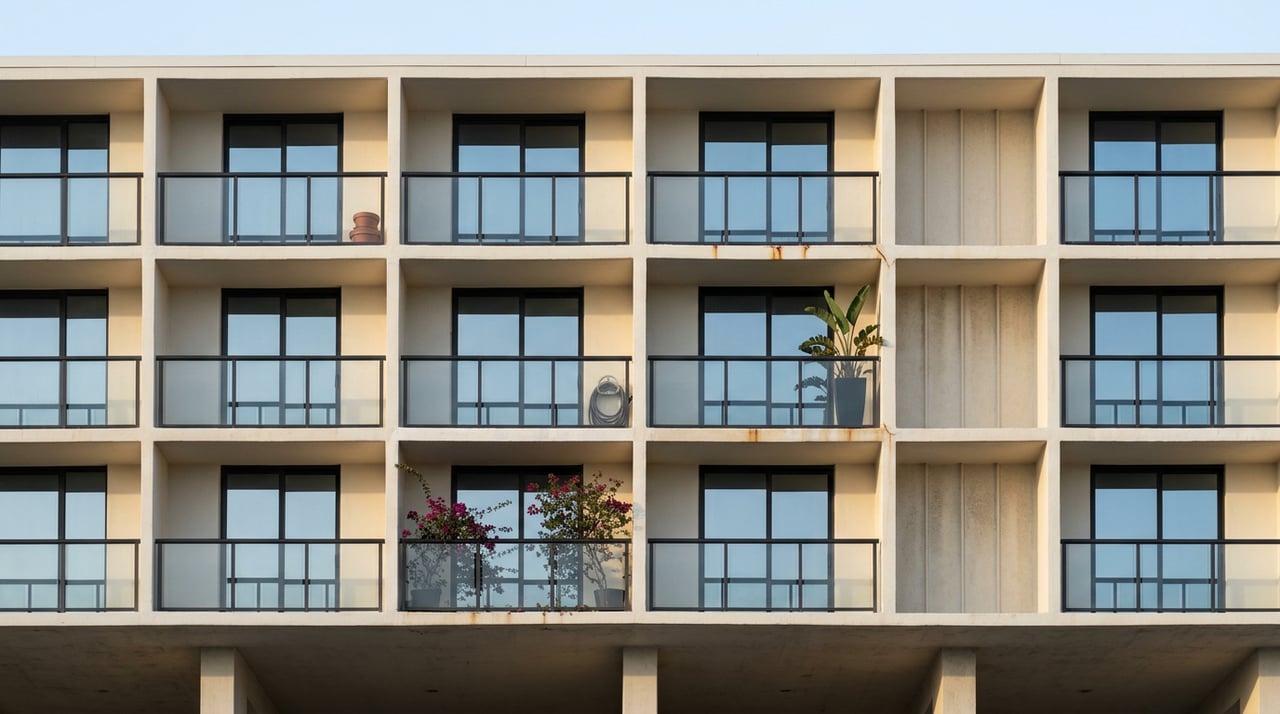
Sixteen years is not old for a building. In most cities, a 16-year-old high-rise is still the newer stock, the one buyers point to as evidence they avoided the risk of an aging property. At 1060 Brickell, a 592-unit, two-tower complex completed in 2008 in the heart of Brickell Avenue, that assumption didn't hold. In November 2024, the board approved a $21 million special assessment, split across facade restoration on Tower II, parking garage and basement repairs, general conditions, and rotunda work. The average bill landed above $35,000 per unit, with some owners facing more than $40,000, a quarter of it due upfront. One owner told CBS Miami he felt like he was "being milked." A contested board election followed, then an owner recall, then a circuit court order replacing the board entirely.
That sequence is worth sitting with before you tour a single unit in Brickell or Edgewater this year, because the story at 1060 Brickell isn't really about one troubled building. It's about what changed on August 3, 2026, two weeks before this was written, in the way conventional loans on units in buildings of more than ten units are reviewed.
The Shortcut That Just Disappeared
Fannie Mae and Freddie Mac called the process Limited Review, and by industry estimates the process covered roughly 40 percent of all condo project reviews nationally.
GoverningDocs reports that Fannie Mae and Freddie Mac eliminated Limited Review, effective for loan applications dated August 3, 2026. Every conventional loan on a unit in a building of more than ten units now goes through Full Review, at every down payment level. A buyer putting 40 percent down faces the identical building-level test as a buyer putting down 10 percent.
That's the part most buyers still don't have their heads around. The old mental model was that money solved association problems.
Why a Fight at 1060 Brickell Still Follows the Unit
This is where the 1060 Brickell case becomes instructive rather than just dramatic.
Roughly 48.5 percent of Miami-Dade condo sales closed in cash in June 2026, against roughly 12.3 months of supply.
Isola Condominium, also on Brickell Key, tells a quieter version of the same story. A 20-year resident described a $19 million assessment for pool deck and garage repairs, layered on top of three smaller assessments, alongside complaints about an elevator that stayed out of service and a party room converted to storage. No board recall, no lawsuit, just the slow accumulation of deferred maintenance finally coming due. Both buildings sit blocks apart.
What to Actually Request Before You Write an Offer
Ask for these documents in your initial inquiry, not after you're under contract. If a seller or listing agent can't produce them within a few business days, treat that delay as your answer.
| Document |
What it actually tells you |
| Milestone Inspection Report |
Whether a licensed engineer found structural distress |
| Structural Integrity Reserve Study (SIRS) |
The remaining useful life and percent-funded status of the roof, load-bearing structure, waterproofing, and other components |
| Two years of budgets and financial statements |
Whether the association is actually funding reserves at the level the SIRS recommends, or still catching up |
| Special assessment history, five years |
Whether the pattern is small, frequent assessments from a reactive board, or none followed by one very large bill |
Reading the Percent-Funded Number
The SIRS is the document that matters most, and the number inside it that matters most is the percent funded, not whether the study exists at all. Before the state's reserve funding deadline, the average Miami condo association had reserve funding somewhere between 40 and 60 percent of what SIRS studies said was required. That gap doesn't disappear.
Starting with the August 3, 2026 rule change, lenders also stopped accepting the older "baseline funding" method and now require a reserve study completed or updated within the past 36 months. A five-year-old study showing healthy numbers is no longer good enough on its own. Ask when the study was last updated, not just whether one exists.
Not Every Assessment Is a $21 Million Problem
It's worth separating what kind of assessment you're looking at, because the range is genuinely wide. In older Brickell buildings, many built between 2000 and 2010, routine capital items like elevator modernization commonly run $8,000 to $15,000 per unit, pool resurfacing $3,000 to $6,000, and parking garage repairs $4,000 to $8,000. Those are normal maintenance cycles, not warning signs.
The number that should change your offer is one tied to structural components such as the roof, load-bearing walls, foundation, and waterproofing. When a special assessment touches those categories, that's a structural catch-up bill, not a capital plan item. At 1060 Brickell, the assessment covered several distinct projects, not a single repair category. Ask which category the assessment falls under before you decide whether the discount on the listing price actually compensates you for the risk.
Brickell and Edgewater Are Being Priced for Risk Differently Right Now
Brickell's condo stock skews older, much of it built in that 2000 to 2010 window that's now aging into milestone inspection territory. Edgewater's inventory runs newer on average, which shifts the near-term risk away from structural catch-up assessments and toward the ordinary teething issues of recently delivered buildings, a different conversation entirely.
Brickell's Q1 2026 market conditions, roughly 17 months of supply and 113 days average on market, are the most buyer-friendly they've been since 2019. That gives buyers real leverage to insist on every document above before removing an inspection contingency, rather than treating the deadline as fixed. In a market with this much supply, waiting a week for the association to produce a current SIRS costs you very little. Skipping that week costs you far more if the building turns out to be one lenders won't finance a year from now.
A Few Questions Worth Asking Directly
Does a bigger down payment still help me avoid this scrutiny?
Not for conventional loans on units in buildings of more than ten units. A 40 percent down payment now faces the same building-level review as a 10 percent down payment.
I found a building priced well below comparable units nearby. Is that a real opportunity or a trap?
It can be either. A 15 to 30 percent discount on a building with a documented, funded repair plan and no open litigation can be genuine value. The same discount on a building with an unresolved assessment fight or a stale reserve study is usually the market pricing in a risk you haven't identified yet.
Miami-Dade's official Condominium Special Assessment Loan Program, relaunched through the county's Housing and Community Development office, is also worth knowing about if you're an owner facing a bill rather than a buyer evaluating one. It offers financing help for owners covering the cost of required building repairs.
The building is the product now, not just the unit inside it. Reading that building correctly before you write an offer is the difference between a genuine discount and a six-figure surprise waiting on the other side of closing.
If you're weighing a resale condo anywhere from Brickell to Edgewater to the coastal towers further north, Evan Sophir can pull the milestone inspection status, reserve study, and assessment history on a specific building before you spend a weekend touring units that may not even qualify for financing.
Request a Free Market Strategy & Media Plan.
This article is general information, not legal, tax or financial advice. Consult a qualified professional about your situation.